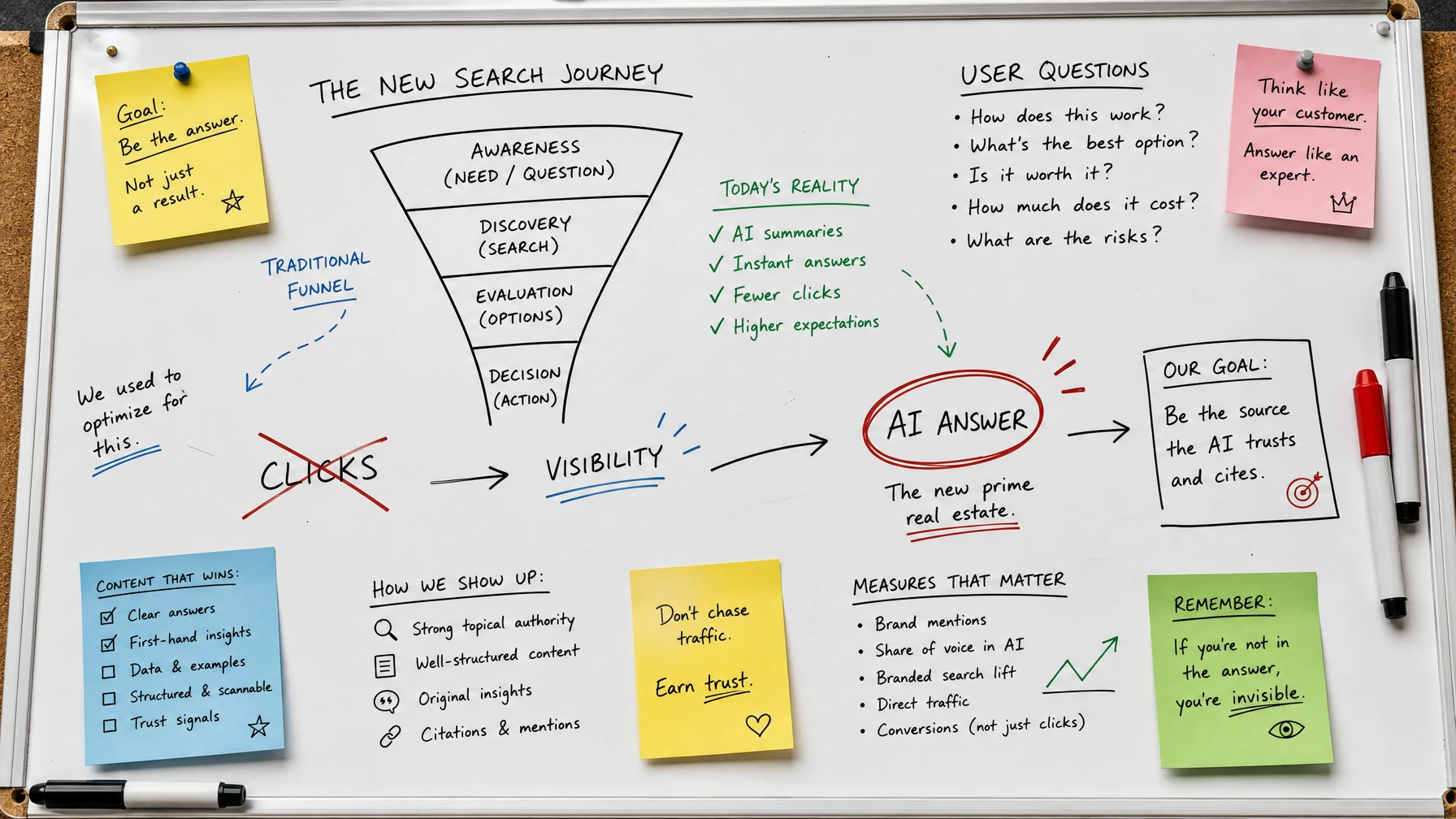
A study published last week found that 68% of Google searches in early 2026 ended without a single click.
No website visit. No phone call. No nothing. Google answered the question right there on the page and people moved on.
That number is going up, not down. And if your business relies on showing up in Google search results to get customers, you need to understand what’s actually changing and what to do about it.
What Google AI Overviews actually are
If you’ve searched Google recently, you’ve probably seen them. Before the regular results, Google now shows an AI-generated summary at the top of the page. It pulls from multiple sources, answers the question directly, and links to a few sites underneath.
Those summaries are called AI Overviews. They rolled out broadly in 2024 and they’re now showing up on a huge portion of searches.
For a lot of queries, it looks like this: someone types “best tacos near West Covina,” Google spits out a paragraph naming three or four places with details pulled from their Google Business Profile and reviews, and the person picks one and opens Maps. Your website never entered the picture.
That’s the shift. Google is increasingly trying to be the destination, not the directory.
What’s new as of June 2026
A few things have changed recently that matter for local businesses specifically.
Google added Business Profile tools directly to the Gemini app. This just started rolling out this month. It means people can ask Gemini questions like “find me a plumber in Covina who works weekends” and get answers pulled from Business Profiles. If your profile is incomplete, you’re invisible to that query.
“Ask Maps” launched. Google Maps now has an AI search feature where people can ask complex questions like “coffee shop with outdoor seating near me that opens before 7am.” The answer comes from Business Profile data. Not from your website. Not from Yelp. From what you’ve filled out in your Google Business Profile.
Zero-click searches hit 68%. For reference, that number was around 57% in 2023. It’s moving fast. More people are getting their answer inside Google and never clicking through anywhere.
The honest part
Here’s what I need to tell you, even though it’s uncomfortable: a lot of the SEO advice you followed for the last five to ten years is less useful than it used to be.
Keyword-stuffed blog posts. Backlinks from directories. Even some of the more legitimate stuff, like making sure your page title tags were just right. That work still matters at the margins, but it’s not what’s going to make or break your local visibility in 2026.
What matters now is whether Google can trust your business information.
That sounds simple. Most businesses in the SGV are not doing it well.
What to actually do
Lock down your Google Business Profile. This is the most important thing on this list. Go to business.google.com and make sure every field is filled out. Categories, hours, service areas, products, photos, Q&A. If you have a plumbing business, list the services. If you’re a restaurant, upload the menu. If you’re a salon, add the photos. Be specific.
Google is pulling this data directly into AI answers. If it’s blank or out of date, you’re not showing up.
Get more reviews, and keep them coming in. I wrote a whole post on how to actually do this. But the short version: the number and recency of your reviews are signals Google uses when building AI summaries. A business with 85 reviews and a 4.7 rating is going to get included in “best plumbers in West Covina” summaries more than a business with 12 reviews from three years ago. Reviews are votes, and Google counts them.
Write content that answers real questions. Google’s AI Overviews pull from pages that directly answer the thing someone is searching. If someone types “how much does it cost to build a small business website in West Covina,” and you have a page or post that answers that clearly, Google may pull from it. If you don’t, they’ll pull from someone who does.
This isn’t about flooding your blog with filler content. One page that clearly answers a real question beats twenty pages of vague marketing copy.
Make sure your NAP is consistent everywhere. Name, address, phone number. Across your website, Google Business Profile, Yelp, and any other directory you’re listed on. Inconsistencies confuse Google’s understanding of your business. Consistent citations help. Tools like BrightLocal or Moz Local can audit this for you.
Add schema markup to your website. This is more technical but it matters. Schema markup is a bit of code you add to your site that tells Google exactly what type of business you are, where you’re located, your hours, and more. It makes it easier for Google to include your data in AI-generated results. If your site was built on Squarespace or Wix, some of this is handled automatically. If you’re on a custom site, it may need to be added manually.
What I’d actually prioritize
If you’re a small business owner in the SGV reading this on your phone between customers, here’s what I’d do first:
- Go to your Google Business Profile right now and check that it’s complete
- Set a reminder to ask your next three happy customers for a review
- Think about the one question people ask you most often, and make sure your website answers it in plain English
That’s it. Don’t try to overhaul your whole SEO strategy this week. Start there.
The businesses that are going to hold their ground in Google search over the next two years aren’t going to be the ones who hired the most aggressive SEO agency. They’re going to be the ones with the most accurate, trusted, well-reviewed presence across Google’s tools.
That’s actually good news for small businesses who do their work well and have real customers who like them.
The practical version of all of this is two jobs: Google Business Profile management so the listing is accurate and answering questions, and local SEO so the site behind it holds up. Neither is glamorous and both are cheaper than people expect.
Want a second opinion on your Google Business Profile or website? The free 30-minute chat is the fastest way to find out where you stand. No quota, no pitch. Just a conversation.